The day my former employer informed me that my services were no longer needed I immediately took two actions. I updated my mobile plans for my phone and iPad, and I cut my cable.
Specifically, I informed Verizon that the package of phone, Fios, TV, and internet I was paying a crazy $250 a month for was too expensive. I hated giving up my land line phone number that included 007, but I was ready to admit that keeping it because it works when the power is out was no longer a good enough reason to pay that much. Plus, last time the power went out, the phone went after eight or so hours.
The lovely person they routes me to spoke to her manager and offered me a reduced price on my package. It was maybe ten dollars less, and did not include the HBO subscription I had at the time. I pointed this out to her. She simply offered the same deal again.
Eventually I convinced her that the only service I want coming across that fiber optic is internet. We reached a deal and that was it. I had cut the cable. Until the next day when I took the cable boxes to one of their stores.
The clerk at the store tossed my boxes onto a ole and trashed the remotes, leaving me annoyed that I’d had to return them at all. In chatting I told her I’d went to just internet. She asked what I was paying and said it was too much. She could offer me double the speed at 60%the price. I was in.
But to do it, she had to cancel my current account and enroll me as a new customer. I agreed. Oh, and my equipment had to be upgraded. Ok. But she could not get a technician to my home for about a week. Gulp.
In the end I agreed. The following week was excruciating. I was trying to look for a job, and I was reliant on my phone as a hot spot, or my pay-as-you-go hot spot that I use for international travel. It felt like an eternity. I rationed my internet use. Finally, on the appointed day, a platoon of Verizon techs showed up to swap out the box installed in my closet. After a couple hours of work, the main technician helped me rename my new router and reset the password so that all my devices would not know anything had changed. And that was it.
I had become a 21st century streamer. I can no longer turn on the TV and be fed content. I have to think about what I want to watch. This was a hard transition. I’ve been using TV for company for many years. Sure, I had an AppleTV. But making it my primary source for content selection was a huge shift. In my expense cutting process, during that no internet week, I had inventoried all my monthly subscriptions and cut several. But now I had to add back in something that provided live TV streaming. I settled on Sling. But soon after I added CBS, now Paramount +.
Weeks later the pandemic hit. I continued my job hunt using my new internet connection and bought a digital antenna for my bedroom TV. My available broadcast stations with it are not great, and the signal isn’t strong. I got a signal direction app and figured out how to aim the antenna and it improved, but it still went in and out–inevitably going out on Colbert’s punchline.
Once I accepted a new position, therefore had the expectation of continued income, I bought a Fire TV stick for the bedroom TV. With all the same apps as the living room AppleTV, at least I have parity, and if one system fails, I can turn to the other. The antenna is my desperation backup.
It’s been more than a year since I cut the cord and I would never go back.
More than a year ago, I started closing the toilet lid before flushing so that my waste would not be aerosolized and spread throughout the bathroom. Because my toilet seat was a slow close type, it soon broke from being pushed down to fast. So one of my many Amazon deliveries last year was a replacement seat. And I developed the habit of getting up, pushing the lid downward, washing my hands, puttering in the bathroom, and then flushing when the lid finally closed.
More than a year ago, I started spritzing my front door knob and lock handles with hand sanitizer every time I touched them. I hung a tiny bottle with a rubbery Baby Yoda on it on my bag. I apply Yoda gel every time I get back in the car. I apply it from dispensers in stores. I wipe down shopping cart handles with the wipes every store provides. I used to be a critic of hand sanitizer. An epidemiologist I worked with hated seeing the stuff in the hospital, saying that it leads people to think it’s as good as hand washing. It’s absolutely not. Hand sanitizer does not kill everything, so you end up with evil critters in gel on your hands. Of course, the evil critters in a hospital are usually a lot nastier than the ones on shopping cart handles.
More than a year ago, I started singing two and a half verses of “Baby Shark” while I wash my hands and ponder how the whole singing as you wash system works when people don’t sing at the same pace.
More than a year ago, the pile of cloth face masks on the chair in the entry started to grow. First I ordered a few from some discounter in China. Then I ordered from Buff USA, which sells the other face covering I use–buffs (neck gaiters). I also ordered filter inserts, and then learned that they were hard to find. I felt like a TP hoarder. Then Crazy Shirts offered masks in tropical prints. I ordered a hard clear plastic one and decided it’s awful. Then a relative made them from beautiful batik fabric and sent me some. Another cheap vendor had one that looks like my parrot. And during President Biden’s inauguration I saw a woman wearing the prettiest one yet, and the camera lingered long enough for me to read the prominent label. It was for charity, so I bought two. When I was allowed to get a haircut, my hairdresser gave me a plastic “cage” for under my mask to keep it off my nose and mouth. She’d bought a ten pack. More than a year ago, I didn’t know that face mask technology would become a hobby.
More than a year ago, I removed the colorful glass chunks from the sink because they seemed to be unhygienic. I put them back the day I received my first Pfizer vaccine dose.
And through it all, I never overbought toilet paper and I never ran out.
Recently, at work, something changed my display name in Webex from Mia to Susan Mia. I didn’t notice until people started asking me “Is your name Susan?” and saying, “We have a new person in the meeting, welcome Susan.”
In most work systems (Slack, Jira, etc.) I’m Mia. But now Webex is picking up my name from some source that has it’s full form. Yes, I’ve tried to change it. This is similar, but limited to only me, to when everything switched to use ALL CAPS for last names a couple months ago. That change was brought about by ongoing integration of our systems with our France-based parent company, though. (The French always use all capitals for last names in formal situations. You get used to it.) This sudden insertion of my first name in every meeting I attend or run feels like a personal affront by the technology.
I mean, I do need my official records with my employer to have me as Susan. I’m Susan to the IRS. I’m Susan to the DMV. Most of my life, when I’ve received a letter addressed to Susan, I know it’s “official.” Phone calls to Susan? Well, back when I answered unknown callers, I’d know it was someone I probably didn’t want to talk to. Like all normal people these days, if I don’t know who’s calling, I don’t answer. Sometimes if I do know who’s calling, I don’t answer too, but that’s a different story.
I know when I’m called Mia instead of Susan that I’ve made a personal impression. My dentist is a great example. My insurance is for Susan, of course, but they’ve twigged on to my use of Mia without my even telling them–they make effective use of Facebook.
Throughout my life, I’ve encountered quite a few people who have a hard time understanding middle name use. Their reaction to me can range from curiosity–“why do you use it?”–to annoyance–“you’re confusing me”–to suggestion that it’s a character flaw–namely vanity. But the truth is, there are many, many people who do it. I don’t have enough fingers to count all those I know personally. And there are plenty of famous people throughout history who went by their middle moniker.
It’s just not that odd, people!
There are two reasons why I use my middle name. The first is the reason I understood for several decades of my life: In the fourth grade, there were three Susans in my class, and my last name was alphabetically last. I did not want to be “the third Susan” (and I do believe the teacher actually called me that, but maybe I only imagined it). Within the first week or so of school I asked her, and my mother, to call me Mia. And they did.
I only realized the other–perhaps the real–reason in the mid-1990s after my mother’s death. In the spring of the year I was in third grade, my father passed away quite abruptly. Throughout my childhood my Mom had told me about how when I was born, the little girl after three boys, my dad wanted to name me Mia. My mom figured he was thinking of Mia Farrow. So my mom decided I would be named after her. She was Dorothy Susan, known as Sue (see, there’s my first example of a middle name user right there). She compromised with my dad by naming me Susan Mia.
So a few months after he died, when my mom was mourning the loss, I abruptly decided to use the name he picked instead of hers.
Nice kid, huh?
To be clear, I do not recall thinking of it this way when I was nine. And I also do not believe my mom resented my choice. As another Susan said to me recently when I explained my use of Mia, “I’m sure your mom loved you honoring him in that way.”
Other than annoyed bureaucrats, the people who had the hardest time adjusting to the new me were my older brothers. Bruce, the youngest, was in college by then, so my change, on top of the death of his father, threw him. I don’t know how long it took middle brother Ralph to make the adjustment because we simply weren’t in contact that much in those years. He was busy raising a young family an hour and a half away. David, my oldest sibling, probably made the shift most easily since he lived nearby and saw me regularly–especially during those days.
I first became aware of the artist Cristo in the early 1980s when he and his wife Jeanne-Claude surrounded some islands in Biscayne Bay with bright pink fabric. I thought it was ridiculous.
Over the past two years I have been developing a new appreciation for modern art. I have made trips to London’s Tate Modern and Bilbau’s Guggenheim for the express purpose of immersing myself in the modern masterpieces on display there. I’ve kept an open mind, and I have, in fact, come to appreciate far more eclectic works of art than I expected.
So I was excited when New York City approved Cristo’s installation of The Gates early in 2005. After all, since those islands in 1983, Cristo has created massive fabric constructions all over the world. Like it or not, he’s a major figure in modern art, and this was an opportunity to gain a better understanding of his work.
The cynical side of me couldn’t help noting that the 16-day exhibition in Central Park coincided with the International Olympic Committee’s visit to review the city’s bid for the 2012 games. But that’s another story entirely.
I drove into Manhattan (my tolerance for the subway in from The Bronx is almost non-existant) on a cool, sunny Sunday and made my way to the 72nd Street western entrance to Central Park.
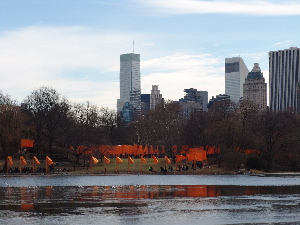
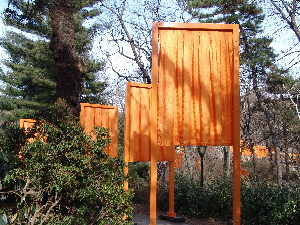
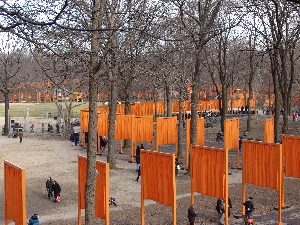
The great orange rectangles with their swathes of swaying fabric dominated the landscape. Every path was a surreal, modern colonade, every view a scene of marching orange figures.
Central Park has certainly never been so crowded on a winter day before. I went north through the Ramble seeking vistas of the strange scene.
On a rustic bench someone had created their own commentary on the “art”: a row of bright orange Cheetos. I wondered how Cristo would feel about this amusing contribution to the event. I hope that he can appreciate a gentle send-up of his work.
The gates were sized to match the paths over which they marched — some were very wide, others narrow. On a wooded hilltop a row of gates intermingled with the trees created an intimate setting. For a moment I was alone with them, the light fabric rustling in the breeze, reflecting the sunshine. And I was able to appreciate Cristo. Certainly his work was challenging many viewers — I heard many strollers asking “why?” and “what’s the point?”
But just as many were strolling and looking and watching one another. Get out into the world, his Gates demanded. Interact with one another. Interract with this strange phenomenon. Be challenged and see what comes of it.
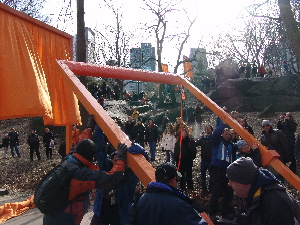
And then my natural curiosity about the construction of things was satisfied. I’d tapped on a few of the frames, reached up and touched the fabric, examined the heavy steel bases. But near the southern end of the park I joined a small crowd gathered around a “fallen” gate. Not fallen, really, but taken down by some of the many workers maintaining the exhibit. The fabric, they explained, had become torn. While we visitors looked on the workers disassembled the gate in order to replace the top — a single unit of frame and attached fabric. They stood the gate back up on its based and fastened it down. And then one of them pulled the Velcro strip that freed the new fabric panel.
A mini-unveiling just for those of us gathered ’round. The new fabric was creased and stiff from its packaging. It looked very different from the gates on either side. I climbed a rock overlooking the repaired gate to study new and old. Jarring. That’s what it was. I wondred how long it would take for the new fabric to uncrease and blend in.
I wondered why it mattered so much to me. And I decided the cold was getting to me.
Do I appreciate Cristo’s work more now than in 1983? A little. The combination of a physical installation with the visitor’s interraction give the work a temporal dimension. The contrast of the natural environment with the artificial challenges ones assumptions. Does the bright orange interfere, or enhance the wintry landscape? What would it be like during spring, or summer, or autumn when the trees compete with the saffron cloth?
We’ll never know, of course. The Gates are already gone, their components sent off to be recycled into mundane items like kitchn ware, cars, and thread. And that’s part of Cristo’s message too.
Eleven days after the destruction of the World Trade Center, a muggy September Saturday, I got up before dawn.
I did it so that I could be on the subway before seven to reach the financial district before eight. Eight a.m. was the shift change at the Seaman’s Church Institute and St. Paul’s Chapel, the locations of relief worker aid stations sponsored by the Episcopal Church.
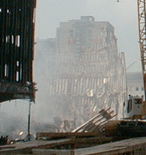
Standing ruins of WTC1 block the view of the World Financial Center from across the plaza
See a map of the World Trade Center areaVolunteering to help with the aftermath of the attack is, like so many things in life, a matter of who and what you know. Andrew and I had managed to get official volunteer slots the previous Sunday, so we knew where to go when to be accepted as workers. We felt lucky.
Although the basic setup at the Seaman’s institute was the same, much had changed in a week. Power had been restored (and therefore the elevator).
Workers take a lunch break near the Corner Store (bagel cart in center rear).
The desperately painful sense of mourning had been replaced by determination and pride. The upstairs café was still busy with police officers and workers. Bacon, eggs, and waffles were still being cooked on baking sheets over charcoal fires on the patio. But today there was conversation and even, occasionally, laughter. Last week there was a respectful hush.
We worked for a couple hours. Andrew mopped the floor. I kept the cooks supplied with utensils, pans, and boxes of donated waffles. There were plenty of helpers sent from churches all over, so when an opportunity arose to go over the St. Paul’s, we took it. Donning hard hats and green “church volunteer” ID tags, we walked west on Fulton Street.
There are three types of officials guarding the approaches to “the Pile:” NYPD, State Police, and National Guard. We had learned the previous week that the NYPD officers were the best to approach. It’s their city, so they seem to give consideration to requests from its citizens. The others tend to opt for a “no” answer when confronted with an unfamiliar request. We knew that our church id’s were pretty much meaningless in an official sense. What got us through to St. Paul’s was courtesy, a determined “I have business here” walk, and approaching the police, not the army.
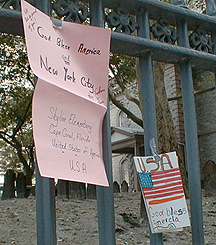
The front of St. Paul’s Chapel draped with messages from America.
Most people, at some point in their lives, have an opportunity to view a public event from a restricted location – backstage concert passes comes to mind. Getting close to what was once the World Trade Center is one of the most powerful such experiences I’ll ever have.
St. Paul’s Chapel and its antique graveyard take up a small block bounded by Vesey and Fulton on the north and south, Broadway and Church on the east and west. In 1789, after his inauguration, George Washington worshiped at St. Paul’s. These days the small, airy space serves an equally significant purpose. The chapel entrance is on Broadway, protected from the devastation and, now, decorated with banners covered with hand-written messages to the rescue workers. Tables on the front porch offered coffee and snacks – a grim sort of church coffee hour display.
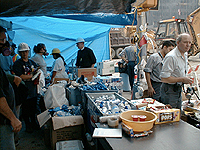
Stockpile of donations in the Corner Store
Inside a national guardsman sat in a pew, head in his hands. What unspeakable horrors had he taken this time to contemplate? What visions was he seeking to expunge in the quiet of this sanctuary? A few rows away a police officer lay somewhere between sleep and unconsciousness loosely covered with a donated blanket.
Cards from children on the churchyard fence.
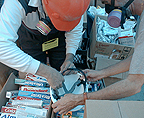
A cleaning crew negotiated their way past the barricades and came in to clean the chapel. Diligent workers more accustomed to tidying offices like the ones that lay in dust all around us worked their way around the sanctuary with cloths and mops. They carefully pick up each item stored on the deep window sills, wiped it off, wiped beneath it, and put it back exactly as they found it. Underpaid, overworked office cleaners tidied up the packages of cereal and boxes of Band-Aids in this new, strange workplace. And while they worked, a volunteer paused to kneel before the altar, and then a national guardsman did the same.In one of this crisis’s most ironic events, the Department of Health had visited the chapel and tried to site it’s emergency food service operation. Andrew was there on Tuesday evening, a week after the attack. The health inspector tried to prevent the distribution of turkey sandwiches because they were not on ice and they contained mayonnaise. The police officers being served drove off the inspectors. The sandwiches were consumed long before the mayonnaise had time to sour. But the inspectors had persisted.
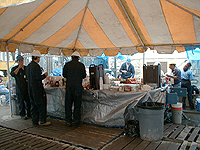
A Red Cross food station adjacent to The Corner Store.
On Wednesday freshly made sandwiches from a deli were being distributed. The health inspectors appeared, seized the sandwiches, and poured bleach on them. That was the end of open bowls of chips and snacks – set out by volunteers to create a sense of home. By Saturday the apples were individually wrapped in cellophane, and the volunteers were spending a lot of time keeping the coffee service area free of the ever-present dust.
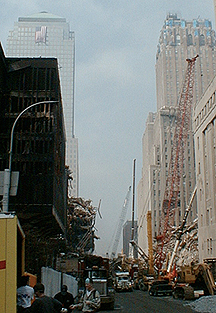
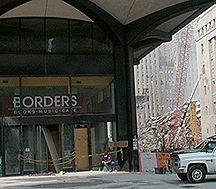
Looking west on Vesey Street, the ruins of building 7 across from the burned out building 6 (Border’s). An American flag graces the top floors of the abandoned American Express tower, upper left.
We were already growing weary when a request came for cases of Red Bull, that exotic “energy drink,” to be brought to the “Corner Store.” We each took two cases of the stuff (someone – probably the distributor — had donated more than 200 cases) and, securing our hardhats and white dust masks, trooped out around the corner and down Fulton Street toward Church street.I’ve walked that block countless times, but never again will I come out of the Subway at Broadway and walk beside the churchyard on my way to the World Trade Center. I walked on that side of the street because the service entrance of the Millennium Hilton across the street was usually blocked with trucks, while on the chapel side the sidewalk was clear except for a bagel cart selling coffee and pastries in the morning.
The Corner Store
On Saturday a road crew was digging a trench in of the center of the street with a backhoe. The racket this operation generated dominated the block. We went past a tarp-tented aid station where more supplies were stored, past more cases of bottled water, and entered the Corner Store.
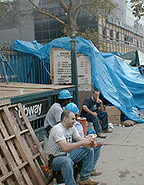
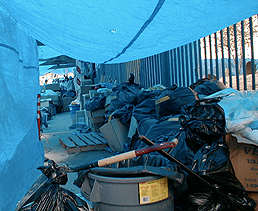
Tarps had been tied to the 200-year-old churchyard fence and suspended across the sidewalk to form a blue-lighted tunnel that rounded the corner. A few feet along the bagel cart formed a barrier and tarp support. Inside it’s hazy window oranges and applies rotted on a shelf. Bags of donated clothing, face masks, and first aid supplies were the blue-light special in the Corner Store. We helped put the Red Bull on ice, then looked around for what more we could do.
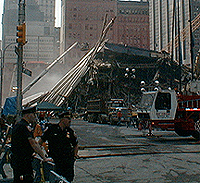
Vertical facade pieces from a collapsed tower lean against the rubble of building 5.
A closed subway entrance draped with messages to the workers.
For that’s the way these aid stations worked. In the eight or nine hours I spent there these last weeks, rarely was anyone identified as absolutely “in charge.” When someone was identified as having authority, it was often because they had been there longer than anyone else had. By this system, once I was in a location a couple hours the newer volunteers came to me for direction. Clearly there were agents at work at a higher level seeing that ice was obtained and the donated supplies were distributed. But to we volunteers, and certainly to our customers, it was a divine mystery.
We were at ground zero now. The rubble had been cleared from the street and sidewalks and even, to some extent, from the graveyard. But the trees and lampposts bore evidence of extraordinary events. At first I thought a tangle of white strips on the top of a street lamp was shredded paper. Then I saw another such bundle hanging in a tree and recognized a venetian blind. In what high window had it hung before September 11th? What story could it tell of its flight and landing in those branches? From what floor had the ordinary black office wastebasket come that now stood like an imposter beside an ancient tombstone?
First Aid Supplies, the Blue Light Special
Border’s Books — entrance to the underworld. The rubble of building 7 can be seen behind it.
The Corner Store was across the street from 6 World Trade, the northeast building, which once housed Border’s Books, a child daycare center, and several floors of offices. The building stands, but its windows are gone, it’s interior blackened. I peered across the street at it. Go through those doors under the still hanging Border’s sign; turn left down the stairs to the mall level and out the store’s lower level. Turn left again past Lechters to the hair salon I’ve been using for the last couple years. Was Fran, the woman who cuts my hair, at work that morning? Did the workers in the salon understand the danger high above and get out in time? I have been unable to find out and it grieves me. But for the guardsmen and police barriers on the sidewalk over there it seems like I could go into the store, go down the stairs, see for myself how a world where I was once comfortable has been rearranged into horror.
Looking into the Plaza between buildings 5 and 6.
Andrew helps a tired worker assemble a new hard hat.
Instead I turned to the task at hand. Boxes of particulate filtering masks had arrived (another of those divine organizational events). A worker urged us to screw in the filters and put them on, that our white fiber masks were inadequate. The national media had repeatedly reported that there was no asbestos on the air here, but we took his advice and exchanged our masks. The new masks also filtered the smell, a worth while benefit, asbestos or no. It was not, as some have started to say, the smell of decay. We were not near enough to The Pile for that. But the acrid, burnt smell that permeates the area is bad enough. After a time it irritates the throat in the way that sleeping in a room with a bad chimney does. Lower Manhattan will not easily shed the smell, either. Even when the rubble is gone, the very stones of the remaining buildings will retain the scent of this tragedy.
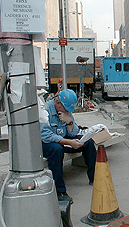
A ConEd worker studies a wiring diagram amid the chaos.
I had left my backpack in the chapel, and after nearly an hour at the Corner Store it was clear we would complete our shift helping there. So I went back up the block, around the corner, and into the chapel. Someone had set out vases of fresh flowers. Gentle light filtered in through the dusty windows. The freshly washed marble floor shone. A rescue worker had uncovered the keyboard of the piano and was playing. Others sat or lay in the pews. I retrieved my bag and hurried out of this surreal Nordstrom at ground zero.
A ConEd worker studies a wiring diagram amid the chaos.
I grabbed a case of water to carry back to the Store and walked past the guardsmen on the corner. Out of the corner of my eye I saw one look my way, but I guess my determined stride, and the water, lent me credibility. Then a passed the stack of water halfway down the block and felt really silly carrying mine from the chapel. Oh well, it worked.
The rest of our shift was spent assembling masks and seeing that new workers received them. Many of the workers who visited us spoke little English, and, as with the cleaning crew, Andrew and I exercised our meager knowledge of Spanish to help them protect themselves.
We marveled at the workers who were delighted to get the cold cans of Red Bull. Finally I tried one: somewhere between lemonade and Gatorade, with a bitter aftertaste. I did not experience the buzz that it’s reported to give. Maybe just being at Ground Zero had already provided all the stimulus my system could manage.At last, exhausted, we turned in our good masks for others to use and made our way back along Fulton Street. It was 12:30, and the crowds of spectators had gathered behind the barricades at the intersection of Fulton and Broadway. They saw two weary civilians – two lucky individuals who’d somehow gotten “inside” — wend their way through the emergency vehicles and officers and step around the barricade to re-enter the free world. We walked back to Seaman’s and went upstairs for lunch. Tired as we looked, we were treated by the volunteers there – a new shift who didn’t recognize is from the morning — with the same respect as the police who were our dining companions.
I don’t believe I know an exceptionally large number of people, but I meet them in airports with uncanny regularity.
Scene One
A number of years ago I was traveling with a co-worker from New York to Washington, D.C. for a press check. While we waited to board at the shuttle terminal at La Guardia, I was greeted by a group of software developers coming off an arriving plane on their way to a meeting in our offices. Leaving the gate in Washington, we ran into another co-worker who I knew but my companion did not. “Geez, you know people everywhere!” she said.
Scene Two
In the fall of 1999 Andrew and I were waiting at the gate for a flight to Paris. I noted that a woman who was having a loud argument with the gate staff at the check-in counter looked like someone I used to work with — someone who was just the type to scream at airline staff. As we watched, the woman stalked away from the counter to the pay phones and was then heard complaining about her seat. No, surely my old co-worker would have a cell phone.
We got on the plane. Having booked late, Andrew and I were seated in middle seats several rows apart amid a large group of college students going for a year abroad. I put my head in my book and successfully ignored the cacophony around me until I heard my name. “Oh no,” I thought, “it WAS her.”
I looked up to see someone entirely different in the aisle – the woman who had booked my trip to Turkey the year before. She was on her way to Paris with her daughter for a week’s vacation.
Back to my book.
I heard my name again. “Oh no,” I thought. “This time it really is her, I recognize her voice.”
I looked up. “Hello!” I managed not to say, “so it was you being so difficult outside.” She was on her way to Paris on business, and her husband was traveling there on a different flight (“ah hah,” I thought, “that’s who she called, and they must have booked late if they couldn’t travel together, so no wonder she couldn’t get the seat she wanted”).
By now the college girl next to me had noticed and commented on my “popularity.” I assured her that I was quite amazed myself. The flight took off and after the seatbelt sign went off Andrew came up to my row. We chatted for a moment and he went away. I turned to the girl next to me and seeing her quizzical look I assured her that I knew he was on the plane.
Scene Three
Park City, Utah, Martin Luther King weekend, 2001. Andrew was downhill skiing at The Canyons. I’d done some crosscountry at White Pine Touring Center and retired to the out-door hot-tub at The Canyons to wait for my massage appointment. I was reading in the tub when I heard the door to the spa open and glanced up to see a group of people in street clothes come out onto the patio. One of them was pointing out the features of the spa to the others. Through the mist rising off of the tubs, I recognized two familiar faces.
“Albert!” I called out. My client at American Express looked up, peered through the mist at me waving, then came over, followed by his associate Andrea. Albert and Andrea handle corporate meetings and events, and they were taking a tour of a potential event location. They’d been at an event all weekend over at Deer Valley. We were in the midst of a busy project and had exchanged extensive email on Friday, but none of us had mentioned to the others that we were coming to Utah over the weekend.
Later in the week I received a message from Andrea to “spa girl.” I billed them for 15 minutes for our pool-side meeting.
Scene Four
A month later I sent Andrea an email telling her I’d be away for several days around President’s Day weekend. She asked where I was going. I replied that I’d wanted to find a place that she wouldn’t follow me, and since the Amex corporate meeting was in Paris the previous year, I figured that was safe this year.
“Are you serious?” she replied, “My boyfriend and I were talking about going to Paris this weekend.” But they had decided not to.
The following morning Andrew and I arrived in Paris and were making our way hazily through the gauntlet of baggage claim and crowded arrivals hall toward the exit. I hear my name. A little unbelieving, I look for the source and find, no, not Andrea, but Mary Kate, one of her associates at American Express. She was there for a corporate event at EuroDisney.
I would not say that I travel all that much. I know many people who travel for business all the time and don’t meet people they know.
This story of early wireless technology is quaint, at best, but the struggle was real!
It all started because I had to get a “hands-free” accessory for my cel phone for driving (stupid law, I can still eat a hamburger while driving, which is way more distracting than holding a phone. But anyway . . .). It turned out my phone was so old (4 years) they don’t make a hands free attachment for it.
This didn’t surprise me, so I had gone into the store prepared to buy a new one. As long as I was there, I found myself looking at the “wireless web” display. Hummmm. $60 for that, which also would not work with my old phone. But here’s a nice little Motorola that comes with the Web kit and can handle a hands free attachment for $200. Or there’s the one for $140 without out the web piece.
I liked the Motorola better — seemed a little more durable, so I sprung for it and the separate hands-free attachment. But not with a “boom” mike. I refuse to look like I’m an operator. The mike is on the earpiece cord.
Okay, so, on the wireless web display they had kits for Windows and for Macintosh. By the time I was buying the phone, I didn’t really think about this. I scanned the box and didn’t see either a Windows or Mac logo, so I figured it must have a universal kit — surely the put all the software on a single CD anyway, so it just comes down to the phyiscal connection.
Got it here to SIAC and stuck the cd (which said Windows all over it) into the Powerbook. It whirred and hummed rather loudly, then ejected. I stuck it in to the PC and it mounted and displayed the installer. I cancelled and went to the desktop to click on the cd icon. It booted the installer. Explorer was unable to display a directory of the CD. So it’s absolutely a PC CD with no Mac files.
Grrrr.
Went to the Sprint web site and found a Mac modem script. Okay, now we’re getting somewhere. Looked in the documentation that came with the phone and found instructions for installing the Mac modem script (which I, a Mac user since 1984, did not need). But I was perturbed that they would tell me how to install it, but neither provide it nor tell me where to get it. Then they told me to go to the Modem control panel and select USB as my modem location. No such choice. For that matter, the phone came with a lovely serial cable and a male/female adapter, but no USB adapter. But I have one at home, so I decided to be patient.
I found my adapter and tried again. Ah hah! The Mac recognized that it had something attached to the USB port, but it didn’t know what. So it was definitely not going to add the USB port to the Modem choices.
Grrrr.
Back to the Sprint web site to find a USB driver. Not there. I composed an explanation of my problem in their “contact us” form and sent it fluttering off in to the corporate support black hole. To my amazement, I received a reply the next day, suggesting that my problem was “of a technical nature” (duh) and I should call the tech support department (and gave me the number). So I called, and the second guy I talked to was able to explain that I needed either a Belkin or a Keyspan USB to serial adapter, and to “look in the PDA department at any computer store.”
Okay, good, I can do that. I can buy more stuff. Good thing he mentioned the PDA connection, because what I really needed is called a USB PDA adapter. When I searched under adapters at the various online stores it didn’t pop up. I finally found it on the Belkin and Keyspan sites, got part numbers, and was able to find the Keyspan one in stock under PDA accessories at MacZones.
It arrived Saturday morning (at no extra charge for Saturday delivery). So right away I put down my ironing and hooked it all up. I installed the adapter driver, rebooted (although the install instructions didn’t say too, I figured I had to since I still got the “there’s something connected to my USB port that I can’t identify” message from the Mac), and went to the Modem control panel. Like magic, the USB option was listed. I selected it, remembered to change the phone number to match the cel phone requirements, and, at long last, got connected to Earthlink. At 14.4.
I knew all along it would be a slow connection, but you forget just what that means when you use a T1 or DSL all the time. But that isn’t the point. The point is, I overcame all the obstacles that Sprint threw in the path of us Mac users. Now I’m going to compose a note to them demanding, on behalf of the Mac user community, that they at least put the compatible adapter information on their web site–it would save them at least a couple phone calls from the two or three other Mac users who try to use their service.
And, of course, now I have to carry around the phone to USB connector. But what’s another wire?
We’ve all encountered them (maybe you are one): women who flush the toilet when they step into the stall in a public facility. As a child of the California desert, and a sailor, the water waste offends me. But I’d like to get past that to consider what motivates some women to pre-flush in public.
Women are, as women know but hate to admit, public toilet slobs. The very nature of feminine hygiene is somewhat to blame, it’s more complicated and requires more accoutrements. But it doesn’t excuse lapses in common courtesy, like making sure the tissue seat cover actually flushes and isn’t left half in the bowl and half on the floor for the next gal. And need I say more than “squat splashback”? (Well, maybe I do–you know, when you squat instead of sitting for fear of what’s on the seat, and the extra elevation caused more splash.)
Most women, on entering a public toilet, are like the mom I heard guiding her young daughter in the public facility at a Utah ski resort, “Don’t touch anything. It’s filthy. Don’t let your clothes touch the wet ground! No, I’ll flush it with my foot . . .” And Utah’s toilets, even in the ones drenched in melted snow and sprinkled with gravel in the ski base lodges, are infinitely cleaner than the typical New York restaurant john on a good day.
No wonder women approach strange toilets with trepidation. But I’m still at a loss to understand how flushing before you use it helps. Assuming the last person flushed (and actually took note of whether the flush was effective–but most women, seeing an unflushed toilet, will move on the next if they possibly can) how does changing the water in the bowl improve the public toilet experience? Do they do it at home, too? How long does it take their toilets at home to refill?
The Courtesy Flush
Like so many of society’s dirty little habits, Jerry Seinfeld brought the courtesy flush to light in his sitcom. I don’t recall the specific episode, but George was undoubtedly involved. ItÕs another public toilet requirement, aimed at making the experience a little more pleasant for everyone. WeÕve all been there, maybe it was something we ate, or a particularly stressful day. But the courtesy is not to be confused with . . .
The Cover-up Flush
This is a distinct variation on the courtesy flush, intended to cover up embarrassing sounds so that the unfortunate perpetrator doesn’t have to slink out of the restroom hiding her face, or wait until nobody else is around before coming out of the stall. Some women, even when experiencing intestinal discomfort, will hang on until they can use someone else’s flush for cover. This is particularly impressive, given the circumstances.
The Inspirational Flush
Distant cousin of the childish prank of putting a sleeping person’s hand in a cup of warm water. Sometimes your body just need a little encouragement
I these pandemic days, stories of our nation’s last enormous, culture-changing event may seem quaint. But perhaps there are lessons to be learned and applied today.
Ordinary (and extraordinary) people share their thoughts about our post September 11th world.
From a NYC Firefighter
Ken Rogers is a New York City Firefighter and also a member of St. Bart’s Sailing. I’ve sailed a lot of miles on Long Island Sound and in the Caribbean with Ken. On Tuesday, September 11th, he was one of the people about whom I worried the most. I reached him by phone early on Wednesday morning and wept in relief when I heard his exhausted voice. He had been there. He was alive. Firefighters he’s worked with for years were not. As of October 21st he was still attending funerals.
Ken in October 2001
Sunday, September 16th,
All over, people are leaving flowers and lit candles by firehouses. They cheer and wave when we drive by. They look at us sadly from a distance. They approach carefully and speak their sympathy. We have received cards, food, and discounts for funerals.
At the site, a thousand volunteers are unused every day. They come from all over the country, and transportation was very restricted for most of them.
Today I finally have a break in the pace for the worst of reasons. I am going to a funeral, the first of many to come.
Ken Rogers
Ken has also emphasized that one of the best ways you can help is by contributing to the fund for the families of the lost firefighters.
From California
Wow.
When I heard about the first plane (as I was sitting on the toilet listening to NPR…”and where were you when you first heard?” oh well, it WAS 5:45 AM here, afterall)….anyway….when I heard about the first plane, I thought some idiot obviously has some navigation training needs.
When I heard about the second plane, it hit me that I was, am and will always be a New Yorker, and they hurt my city. It was as if a personal friend was attacked. Those Towers, were the sentries that guarded us (at least from New Jersey or Staten Island). The Empire State was the beauty and the Towers were the strength of NYC architecture. All week I was crying, sobbing saying “they hurt my city.” At the time I didn’t know that they’d also killed my cousin.
But, you know? Now that I know they killed my cousin (controller of Windows on the World), it doesn’t feel much different from them hurting my city. We all experienced hideous losses, when it hits your family it’s just more in your face. Though watching it first hand is in your face enough.
For the first week, I stayed up late watching TV. I couldn’t get enough of it. I watched the telethons and gave the money. It seemed so surreal to send disaster relief money to the city you lived in for 27 years and that is the richest city in the world. Now I think I’ve shut down. I watch sitcoms (yeccch) and only occasionally watch the news. When I think about Howie (cousin), I don’t feel anything. I try to go through the days as if everything is normal. It’s a lot easier to do from 3,000 miles away.
I see American flags all over and something about them bothers me. I know it’s supposed to make people feel better. But to me it smacks of “my team is better than your team…my country is better than your country…my way of life is better than your way of life…my religion is better than your religion.” It brings me back to Vietnam when people who were against the war were beaten up for being unamerican, by people waving the flag as an emblem of their superiority.
Mona Rosenthal, Pasadena, California
From Downtown
This breathtaking story was circulated at the Securities Industry Automation Corporation.
The events of September 11 still haunt all of us and will for some time and maybe forever. There are plenty of stories which began on that day, New Yorkers in fights for survival, making their escape from Downtown Manhattan. This is our story, as it happened, from 86 Trinity at the Amex [American Exchange], on that fateful day. This is my account of it, I think it needs to be told.
I was running up Wall Street from Water Street when the second plane hit, my bus had stopped its route at the base of the Brooklyn Bridge to turn around, so I had to hoof it to get to work. The sky was foreboding and dark, office papers drifted down from high above pushed outward by the blast of the impact, like some morbid ticker tape parade. People hurried toward the seaport, some running, some screaming, others crying. This scene accurately foreshadowed what was to come, to an unsuspecting downtown business district.
My team were already busy at work on the [American Exchange trading] floor, as the events unfolded before their eyes on CNBC, CNN and other news services. From the 1993 WTC bombing I had a decent idea of what to do. Since the Con Ed power grid goes beneath the WTC, I went to the Amex service desk to get ready for an immediate powerdown. Before doing so, I ordered all my technicians to the commsite for safety and to keep track of them.
While at the service desk, we saw that the Pentagon had been hit, and felt how widespread this event could be. I went back and forth to our commsite and the desk several times. Then while on the trading floor, there came a crash and the entire building shook. People began to scream and run off the floor. I just remember standing there looking up at the giant high gold leafed ceiling waiting for it to break open in a shower of rubble. I went to the front of the building to see what happened. I went downstairs and looked at the front glass doors and they were as black as pitch. One could not even see the smoke moving across them. It was then that I realized that we were in trouble.
So I proceeded to the Comsite, through a clogged hallway of very frightened people. A senior person was doing his best to calm them and direct them. I moved thru the crowd and went to talk with my team. They were anxious, yet very calm. We handed out respirators which we used to clean equipment and rags which, when wet, would help folks breathe. By this time, a lot of people from the hallways had come into our area also, to seek clean air, which we had due to our old air conditioners which were standalone, and not vented to the outside. We did our best to calm everyone down.
We came up with a plan, and that simply was to evacuate via the back door at 123 Greenwich Street and make our way down to the water’s edge via Battery Park where the ferries are. Hopefully, there would be clean air there. Then we could take ferries, or travel along the coast to the bridges, or just jump in, if we had to. I had a walkman at my desk and gave it to someone to monitor who confirmed that the first building had fallen, much to our shock. Then a third shift tech called in from home and I asked him how did the building fall, How!? He couldn’t tell from the video.
I went out on Greenwich Street, twice, to check the air quality and ash levels, and noticed they were diminishing by the second test. Since I felt that we were targets, too and did not know the scope of what was happening, thought it best to go. Most others thought that way also, so no big decision here. We readied up and the team was together.
Just then, security came in and said the Police want us to evacuate. So there it was, the decision made….time to go….we were ready, our plan in place, our masks ready, we also put hats on which we had from the Amex.
We went calmly in two files out that back door into what can only be described as a Pompeiian situation. It was dark like early night, and the entire area was covered by an Erie grey ash blanket…almost like a new snowfall….we could hardly recognize the landscape, it was like a nuclear winter scenario. We proceeded up Greenwich street and turned left up Rector with the intention to turn right on Trinity Place wherein we would have a direct route to the water and hopefully clean’ air and blue sky at battery Park near the Ferry. We were not prepared for what happened next.
I carried up the rear and yelled for my crew to stay together… Just then, another rumble. Louder than loud….sounding like jets flying over, very close…but no! People began to scream…then run at full pace.. (the second building was collapsing….we did not know that!!)
I stopped and turned to see what I saw…and what I saw rising from the blackness which already draped us….was this monstrous heaving wall of debris, smoke, pulverized concrete and glass , a mass the size of a building , brown and black and much denser then the already blackened sky….It was traveling at us as I stood almost frozen, in what was a timeless second of awe and amazement ….this beautiful, wonderful, horrible terrible mass of fury coming at us from both down Trinity Street and up from Rector Street, on the perpendicular…..like we were in a giant bowling alley… It was moving fast, 150mph fast…I knew instantly we couldn’t out run it. And when the trance of that eternal second was broken…I too, turned and ran…Just then I saw a door to a cafe swinging slightly from the corner of my eye…I grabbed someone in front of me and pulled him in, as the cloud blew by…ominously… Again, we were plunged into complete darkness, smoke began to fill the room, as it had filled the Exchange…and for the second time I really thought that this was it… I thought the building was going to come down or catch fire…all I could think about was what a mess I had left my apartment in, and that someone would have to clean it!!
Several of my crew who were further down the street were knocked down and pounded into the ground. They are all OK, now. Others managed to find refuge in buildings up along our route. They were in groups of two or three all separated from each other. It was agonizing not knowing if everyone was all right, but I trusted in their common sense and survivability. We tried calling on the Nextels which at first was futile. Several of our group were in the café with me along with a fireman from Flushing, and several other fine folks. We just waited to see if the once again blackened streets would clear.
We waited quite a while not knowing what was happening out there, as the soot settled. From my Walkman I learned that the second building had collapsed…I dared not tell anyone.
Outside brief rays of light hit the street, as the ash settled. This was encouraging, and we decided to wait a little more to get better air. Smoke was slowly finding its way into our area, and it was getting hard to breathe… We decided to make a break and complete the escape to Battery Park and the water’s edge. We began to establish contact with the group, meeting at different intervals or hearing of their safety ahead of us. Some took to the ferries, we made for the bridges, upon hearing that all of us were accounted for.
We then made our way to the Manhattan bridge and joined a mass exodus of thosands who wearily crossed the expanse, not exactly sure what just happen, each with their own story, quiet and pensive, certainly happy to be walking to blue sky… looking back periodically at the scarred darkened smoke filled skyscape where the once ever prominent symbols of our beloved city once stood.
This story was just an average story and does not compare to what happened to those at the site; New York’s Bravest, New Yorks Finest, workers, air travelers, moms and dads and kids… all gone in an instant… in a snapshot of time… an event indelibly imprinted in our memories…objectified…
I have seen “gound Zero” several times. I have seen the wreckage right next door… It is awesome, and terrible… and unbelievably close. In the days following the attack we’ve worked to recover the operation, the building and our ability to trade.
We’d come to work over the Brooklyn bridge with police escorts, through many checkpoints, with Army, Airforce, and National guard manning the stations. On the roofs of buildings, anti-aircraft guns were in place, while Helicopter gunships circled over downtown. F-16, and F-18 Fighter jets routinely patrolled the Hudson and East Rivers. This brought a sense of comfort to me, if not a bigger sense of the surrealness of the situation. The place where we worked was indeed a war zone.
Four or five times we were evacuated from our work areas at the NYSE [New York Stock Exchange] or the Amex with bone chilling quickness and renewed fears. The reason was the uncertainty of stability of some of the larger buildings which shadow our area. There was a tenseness which pervaded our beings when at these work sites. No one ever yelled, everyone was always aware of their position in relation to ground zero and those unstable buildings. We always worked in twos or three’s, having radios which communicated with our building’s security desk in case of an alert or evacuation command.
New Yorkers have risen to this challenge and responded to this event not in anger or in blame but in compassion and love and a willingness to help. I have never hugged so many people hello in my life! I have met folks from the nationl guard, the army, fire departments and from FEMA…. as far away as Riverside Calif [!]…I thanked them, they thanked New Yorkers for being so kind!!
Its all been very emotional.
The country has risen to the challenge and the world has responded in kind…We are now closer as a humanity then we have ever been…we have set the example, one of determination and resilience, and that is our best and most poignant retaliation.
I am impressed and proud of my team’s ability to handle this ordeal and to return to work not 24 hours after the event in some cases, to the very spots from which we literally ran for our lives. They represented themselves well in the disaster support effort.
Three weeks slipped by in what seems like a split second. I’d like to commend my managers [names cut for privacy], I like to thank the SIAC [Securities Industry Automation Corporation] techs at the NYSE for supporting us so proficiently [names cut]. An incredible amount of work was completed by SIAC and the Exchanges to demonstrate to the world our determination and fortitude. Again, I thank everyone for their support and their efforts from Security, to Operations, to HR, to Engineering, QA, Development, and Facilities engineering.
There are so many of you and you are all responsible for the statement the Amex made Monday morning, Oct 1st, 2001 by being the first American Company to open within the frozen zone, one block from ground zero. This is SIAC at its best.
I think it was Saturday afternoon 9/29, on my way home, when I heard the bells of Trinity Church ringing for the first time since the event, with power restored , a warm inner light illuminated its majestic stained glass windows. I had forgotten about those bells and what they meant to me. The history of them; when they rung in victory in other churches built on that site, for the sons of the American revolution, for the war of 1812, the Civil war, WW1, WWII…and now again for a tearful recognition of a different kind of victory , but always to the same formula of American spirit, expert in the art of life and the ability to move forward in freedom and democracy.
Those bells sounded so wonderful.
Frank Moscati SIAC Technician
From the Air
This could be a fabrication, but since I only received it once (meaning it wasn’t heavily circulated), and since the details have the ring of truth, I’m sharing it – as with the others here, it’s a story that needs to be told. If you know anything about this story (especially if it’s a hoax), please let me know. The unidentified author apparently lives in Washington DC but was stuck in Colorado during attacks.
I just wanted to drop you all a note and let you know that I arrived safe and sound into Dulles Airport tonight at about 6:00. It was an interesting flight. The airport in Denver was almost spooky, it was so empty and quiet.
No one was in line for the security check point when I got there so that went fairly quickly, just x-ray of my bags and then a chemical test to be sure nothing explosive was on them. Then I waited 2 1/2 hours to board the plane. What happened after we boarded was interesting and thought I would share it with you.
The pilot/captain came on the loudspeaker after the doors were closed. His speech went like this: “First I want to thank you for being brave enough to fly today. The doors are now closed and we have no help from the outside for any problems that might occur inside this plane. As you could tell when you checked in, the government has made some changes to increase security in the airports. They have not, however, made any rules about what happens after those doors close. Until they do that, we have made our own rules and I want to share them with you. Once those doors close, we only have each other.
The security has taken care of a threat like guns with all of the increased scanning, etc. Then we have the supposed bomb. If you have a bomb, there is no need to tell me about it, or anyone else on this plane; you are already in control. So, for this flight, there are no bombs that exist on this plane. Now, the threats that are left are things like plastics, wood, knives, and other weapons that can be made or things like that which can be used as weapons.
Here is our plan and our rules. If someone or several people stand up and say they are hijacking this plane, I want you all to stand up together. Then take whatever you have available to you and throw it at them. Throw it at their faces and heads so they will have to raise their hands to protect themselves. The very best protection you have against knives are the pillows and blankets. Whoever is close to these people should then try to get a blanket over their head-then they won’t be able to see. Once that is done, get them down and keep them there. Do not let them up. I will then land the plane at the closest place and we WILL take care of them. After all, there are usually only a few of them and we are 200+ strong! We will not allow them to take over this plane. I find it interesting that the US Constitution begins with the words “We, the people” — that’s who we are, THE people and we will not be defeated.”
With that, the passengers on the plane all began to applaud, people had tears in their eyes, and we began the trip toward the runway. The flight attendant then began the safety speech. One of the things she said is that we are all so busy and live our lives at such a fast pace. She asked that everyone turn to their neighbors on either side and introduce themselves, tell each other something about your families and children, show pictures, whatever. She said “for today, we consider you family. We will treat you as such and ask that you do the same with us.”
Throughout the flight we learned that for the crew, this was their first flight since Tuesday’s tragedies. It was a day that everyone leaned on each other and together everyone was stronger than any one person alone. It was quite an experience. You can imagine the feeling when that plane touched down at Dulles and we heard “welcome to Washington Dulles Airport, where the local time is 5:40.” Again, the cabin was filled with applause.
It has been a very long day and one that I am glad is over. I have been constantly reminded this day of the article in JAAMT that Barbara Williams recently wrote where she referenced the tornados in Oklahoma and said something like, “Do we get mad and shake our fists at God in anger? No, we go on and conquer our fears and continue our lives.” It is my hope that is what we do now. Last night I saw a program with college students where one of them said that at their campus there are no more hyphenated titles, i.e., African-American, etc., everyone is just an American. No one will ever be able to take that pride away from us.
In the Republique Metro station in Paris, there is a passage between two lines that shortens the walk from one platform to another by about five minutes. But it’s a one-way passage–passengers arriving on one platform may use the passage, which has one-way doors at one end, to quickly reach the other, but hapless riders coming from the other line have to go the long way around. Metro “insiders” know that the latch on the door on the left end is broken.
Since the Paris Metro is notorious for making its riders walk most of the distance they want to travel, this seemingly small victory over the system feels like a coup, particularly to the visitor–doubtlessly Parisian commuters take it in Gaelic stride.
New York
The passengers waiting to board Flight 1599 to Milan was growing restive. Because of a gate change, some of us had made a mad dash from one concourse to another, and the departure time had been delayed by 30 minutes. When gate staff announced boarding of first class passengers, a crowd, bordering on a mob, formed around the gate door in the corner, surrounding a bank of three seats, a pillar, and a trash can situated near the door.
First class passengers squeezed through the throng towing their excessive carryon luggage. One gate staff checked their tickets, while another surveyed the crowd and said, “the line is behind the chairs. You must move behind the chairs,” indicating the narrow corridor formed between the chairs and the wall. Nobody paid him any attention.
Grumbling, he stepped behind the counter and came back with a pair of poles with an expandable strap in between.
“You must get behind the chairs,” he declared again, and tried to force the crowd on the wrong side of the chairs away from the door by setting up his rope and poles.
“Too late,” was the general response, “you should have set up the barrier before you made the announcement!”
“Please form the line behind the chairs by the wall!” he grew agitated.
“This is New York and you aren’t Mayor Guilani!”
Remarkably, the gate staffer continued trying to bend the increasingly angry crowd to his will until he was simply overwhelmed. The passengers moved his barrier out of their way and proceed to the gate.




 Mia's Mar Vista News