The Human Herd

Paris

In the Republique Metro station in Paris, there is a passage between two lines that shortens the walk from one platform to another by about five minutes. But it’s a one-way passage–passengers arriving on one platform may use the passage, which has one-way doors at one end, to quickly reach the other, but hapless riders coming from the other line have to go the long way around. Metro “insiders” know that the latch on the door on the left end is broken.

Since the Paris Metro is notorious for making its riders walk most of the distance they want to travel, this seemingly small victory over the system feels like a coup, particularly to the visitor–doubtlessly Parisian commuters take it in Gaelic stride.

New York

The passengers waiting to board Flight 1599 to Milan was growing restive. Because of a gate change, some of us had made a mad dash from one concourse to another, and the departure time had been delayed by 30 minutes. When gate staff announced boarding of first class passengers, a crowd, bordering on a mob, formed around the gate door in the corner, surrounding a bank of three seats, a pillar, and a trash can situated near the door.

First class passengers squeezed through the throng towing their excessive carryon luggage. One gate staff checked their tickets, while another surveyed the crowd and said, “the line is behind the chairs. You must move behind the chairs,” indicating the narrow corridor formed between the chairs and the wall. Nobody paid him any attention.

Grumbling, he stepped behind the counter and came back with a pair of poles with an expandable strap in between.

“You must get behind the chairs,” he declared again, and tried to force the crowd on the wrong side of the chairs away from the door by setting up his rope and poles.

“Too late,” was the general response, “you should have set up the barrier before you made the announcement!”

“Please form the line behind the chairs by the wall!” he grew agitated.

“This is New York and you aren’t Mayor Guilani!”

Remarkably, the gate staffer continued trying to bend the increasingly angry crowd to his will until he was simply overwhelmed. The passengers moved his barrier out of their way and proceed to the gate.

Thinking Globally

Another artifact of the mid 1990s highlighting a technology that today is in every mobile phone, tablet, computer, and car. Maybe your coffee maker, too. But my conclusion here is as true today as it was back then.

Handheld GPS units are the most remarkable devices. A little gadget the size of a cel phone receives signals from dozens of satellites and interprets what they’re saying to tell you exactuly where you are on the face of the earth. Think about that. Think about how much information you can hold in your hand — geographic information that scores of explorers spent their lifetimes learning. And you can have it delivered to you, from space to your hand, for an investment of under $300.

When I travel, I take my handheld GPS and store waypoints at important locations. I have waypoints across Turkey and France. Although the GPS is ostensibly intended for sailboat navigation, I think of it as a geographic diary. In it’s little memory are the places I’ve taken it. I can tell you, in a matter of seconds, exactlly how far it is from where I’m sitting now to Marmaris on the south west coast of Turkey, or to Angers, a small town in western France. Or the exact spot where my snowshoes didn’t support me in the fine powder and I sank up to my waist in the snow near Quebec City.

Now that’s inherently cool.

However, no matter how much adjusting I do to the thing, the altitude function never seems to be right. I’ll be standing on a 1000 foot hilltop and it will tell me I’m at 200 feet. I’ll be sailing in Long Island Sound and it will say I’m soaring through the clouds. Sailing along in a friendly breeze can feel like flying, but I don’t think the GPS is capable of presenting interpretive data.

So no matter how magical I think my little GPS is, no matter how much fascinating data it can provide, I have to put it down and look around me to see the view from sea level…

Communications Breakdown

This article from the mid-90s(?) is quite dated, but I’ve retained it because it’s a snapshot of life at that time, and it’s very easy to forget.

Is this the party to whom I am speaking…

Long distance telephone providers are responsible for the death of common courtesy in this country. I was raised to answer the telephone by identifying myself. But telephone solicitors have browbeaten me into the most crass of telephone manners out of self defense. I no longer offer callers any information when I pick up the receiver. My “hello” is vague enough to allow me to become almost anyone, from a ditzy spouse of the “decision maker” to hostile hired help. But most often it’s the prelude to a firm “no” followed by a hang-up.

A hang-up! I never imagined myself hanging up on anyone. What would my mother say?

Actually, she would appreciate the theatrics of my occasional role playing: “no, I can’t possibly subscribe to your video series, I’m about to declare bankruptcy.” Actually, the sympathy I’ve gotten from that one has almost made me feel guilty.

But the frequency of phone solicitation has become so frenzied that around here even the practice of yanking their chain has gone the way of the courteous answer. These days, if the caller ID doesn’t identify them I don’t pick up. If I’m near a phone with no ID display (rare since I have three displays) and find myself being asked if I’m “Susan Me … Ma … korskie?” I feel completely justified in answering “no” and hanging up.

During December, Time Life Books sales people called me twice a week. They kept telling me how I was enjoying something called Ancient Civilizations. They repeatedly called back to check up on my reading progress, until I angrily declared that I had not bought the book from them (which was true) and did not want to buy it or any other book from them. When I want a book I order it from Anazon.com. Amazingly, they haven’t called back. If only Gevalia would take the same hint.

To be fair, Gevalia is a little more justified in their persistance. I did, afterall, subscribe to their service a few years ago to get the free drip coffeemaker (a $49 value), then cancelled after a few months, having stockpiled two year’s worth of gourmet decaf coffee beans. I think I used the bankruptcy excuse. A year or so later I broke the carafe and couldn’t find one the same size at kitchen supply stores. So I called Gevalia to order a replacement, fully intending to pay for it. They didn’t have it in my color, and after a couple phone calls back and forth said sent me a whole new coffeemaker. I still haven’t resubscribed.

But the worst by far are the phone companies. There isn’t a snowball’s chance in hell that I’d be willing to listen to long distance plan options and pick one over the phone. Once years ago I asked a salesperson to fax me their plans. She explained that she was an independent contractor working from home and couldn’t fax me. That’s not my problem Š. Click

More recently an AT&T saleswoman rattled off a whole list of benefits before I could stop her. “Do you offer airline miles?” I asked. “Our market research has shown that airline miles is not the best way to serve our customers.” She replied. Not this customer, baby. Click.

I interrupted the most recent salesgirl (I use the term intentionally) who got through to me: “I’m not interested in switching my voice service, but to you offer DSL?” “I dunno, what’s that?” she countered. “It’s a high-speed connection for Internet access, and if you don’t know what it is then I’m wasting my time talking to you.” Click. I’m sure Mom would approve of that.

One Ringy-Dingy, . . .

My local phone company, Nynex which is now Bell Atlantic, sold me this absurd bundle of options that includes voice dialing and a second number on my main phone line that rings differently. In typical 90s managed market style, the whole package is the cheapest way to get the options I really want (voicemail, call waiting, caller ID). My office telephone has a huge number of (mostly unused) speed dial slots, and now my phone service offers me 50 more, in addition to 30 voice dial numbers. As if I’m ever going to program in and remember that many numbers! I can’t even remember how to program the phone.

So they activated this new second number and within a couple hours it was ringing. Guess who called? A telephone solicitor!

For That Price It Should Wash the Car

In mid-December a representative from a carpet cleaning company called to tell me I’d been selected to have the carpet in one room of my home shampooed for free, which room would I like done? Well, I replied, since I only have carpet in one room, it would have to be the living room. Thinking ahead to my New Year’s Day party, and that the carpet had been down for two years without being cleaned, I told them to come on over.

I only have carpet in one room …

I did a little on-line research and discovered that they were actually a sales office for Kirby vacuums. By the time the two guys showed up with their amazing machine I had concentrated all my energy on sales resistance. I’ve been in third world markets. I’ve bargained with Turkish rug merchants. Two boys from Mount Vernon weren’t going to get the best of me!

They set about demonstrating the wonders of the Kirby Generation Six carpet cleaning system. They showed me the dirt their machine could suck out of my carpet. They showed me how easy it was to handle. They showed me how it’s so powerful it can suck the feathers out of my down comforter, and the grout out from between the tiles on the kitchen floor. I was polite enough not to point out that I’m not interested in cleaning my downstairs neighbor’s apartment as well as my own. They showed me the upholstery attachment, the curtain attachment, the plant misting attachment, and the “portable” feature for cleaning the car.

it can suck the feathers out of my down comforter …

I was impressed with the way they built the case for my ultimate purchase, first asking how often I vacuumed, then asking if it wouldn’t be worth $2.50 each time. I was taken aback by the way they overtly checked out my apartment and complemented or expressed mutual interest in color schemes, CDs, the birds, and the shape of my coffee mugs.

I wouldn’t go near a hand-knotted oriental rug with that thing …

Finally, the leader took me into the kitchen to “go over the numbers” while his partner set about shampooing my carpet. Scratching out numbers on a scrap of paper he told me about how he’s in the middle of a sales contest, so he’s offering a higher turn-in value on my pathetic old vacuum, as well as a very reasonable monthly payment plan. I wouldn’t even have to start paying for a couple months, but they’d set me up with a new machine tomorrow. And although he referenced the $1,500 final purchase price, he never actually pointed out that those payments would go on for 18 months — after all, the cleaner is good for at least 25 years. I didn’t bother to point out that at $80 a month, I’d have to vacuum more than once a day for it to cost $2.50 per cleaning. But kindest of all, I didn’t laugh in his face at the proposition that I spend $1,500 for a machine to clean my 12 by 12 foot patch of living room carpet. Was I tempted? Not in this reality. I wouldn’t go near a hand-knotted oriental rug with that thing, and the notion of dragging it out to mist the plants just to get my money’s worth was laughable.

In the end I pointed out that they’ed called me and I’d told them I only had one carpeted room. They couldn’t blame me for accepting the offer of a free cleaning — the initial caller hadn’t said a word about selling me anything. They went away disappointed, but assured me that they weren’t angry. I ended up very happy with my clean carpet for the holidays. I wonder if Hoover has any sales offices in the area …

Survival

This article is from the mid-1990s when I indulged a brief obsession with Antarctic exploration.

he antarctic is about survival. As Morgan in Antarctic Navigation learns during a stint at the US base on the continent, it’s a completely hostile environment.

During the (southern) winter of 1999 a scientist stationed at the south pole for the winter discovered a lump in her breast. For all the high-tech equipment at the southernmost base, there was nothing the outside world could do to help. During the antarctic winter, no plane could fly to the pole, land, and return to the relative safety of New Zealand. Gender aside, she might as well has been a part of one of Schackleton or Scott’s expeditions.

Finally a plane did make the round trip, just barely. But rather than trying to land, it dropped the emergency medical equipment she needed to operate on herself. On the television news we saw footage the other polar scientists taped as they retrieved the package in the icy darkness.

I’d have a lot of respect for nature in a place so remote, cold, dark, and windy that a military jet can’t go there.

In the (southern) summer of 1997 six sky divers went there to parachute down onto the South Pole. Three of them died because they neglected to open their parachutes.

When I heard about this at a cocktail party my first question was not “Why?” but rather, “How. How did they arrange to do such a frivolous thing?” But of course the answer is money–they each paid some enormous sum for the chance to jump the pole.

I heard an interview on NPR with one of the three who jumped successfully. Two who survived were tandem jumping — they were tied together. The other four were to link up in the air for a while before opening their ’chutes. The man being interviewed described jumping from the airplane at 8000 feet (above the ground, which is at 9000 feet above sea level) and beginning to reach for his friends. The next thing he knew he was half way into the “red zone,” which is the zone in which you want your parachute to be out. He deployed it at about 1000 feet and landed. Two of the other three jumpers never deployed their ’chutes, the third had started to when he hit the ground. The Chilean government still has all the equipment (these jumpers probably went through Chile because the US government would never sanction their trip, but I speculate . . .) but it is suggested that there was no equipment failure.

The interviewer asked if he thought they could have been better prepared and he described their preparation as adequate. Then he said they had not jumped together before, so they were unfamiliar with each other’s flight positions and habits. He mentioned that they’d been on oxygen on the airplane, but that he didn’t think any of them were suffering from altitude sickness. Then he described the ground, an endless field of white that lends no sense of perspective.

Amazing as it may seem, as a scuba diver I can understand how they could fall thousands of feet without realizing it, and without checking their altimeters. Placed in an alien environment, the mind and body react unpredictably.

But I cannot understand how they could risk jumping in one of the most hostile environments on Earth without jumping together somewhere safer first. They were not well prepared, they were arrogant. What a sad testament to have died ill prepared in a fatally dangerous sport, having gone out of their way to do it in a tremendously hostile environment.

Travel (which is to say, Shopping) is not for the Faint Hearted

This essay is from the early 2000s. The rug is now in my living room and the basket holds yarn in the bedroom.

Tucked partially under a chair in my office a colorful basket squats, slightly misshapen from being packed, on an equally colorful carpet. Souvenirs both, but neither declares its point of origin. To do so would give away their pedigree . . .

Caveat Emptor

Young rug weavers near Izmir

To visit Turkey and not buy a carpet is to defy some law of Byzantine nature.

“Beautiful Kilims!”

“Just step into my shop, only for a moment.”

“Where are you from? You want to buy a carpet?”

Swarthy men try to be non-threatening while exuding Turkish aggressiveness. My first carpet, bought my first day with two weeks of shopping to go, represents a moment of weakness. It’s not a bad rug, just not a great one.

The Turkish carpet salesman is one part used car salesman, one part art dealer, one part psychic. He reads you as you approach, speaks your language, describe his products in historical, cultural, falacious detail, and convinces you that you need a carpet for the foyer in the home you may one day move to.

Most Americans have never experienced anything like Turkish carpet shopping. It’s far more seductive than a Turkish harem, much more dangerous than Turkish prison, and approached properly, as much fun as a Turkish bath.

Never Let Them Know What You Want

You venture into a shop draped with intriguing silks, kilims, and woolen rugs. He urges you to sit, take some apple tea or Turksih coffee, let him show you some things. You’re weary. You’ve heard that if you accept a drink you’re agreeing to buy something.

“What size?”

“What colors?”

John examines a rug on offer in the Istanbul market

In no time his minions have unrolled a half dozen marvelous specimens. It would be impolite not to at least look. “Which do you like? I’ll show you more like it.” You’ve been warned not to let on which you like. But your every gesture and glance tell him volumes. Like a lamb to the slaughter, a minion separates you from your discouraging friends and negotiates a price. You emerge blinking and dazed into the sunlight with a tightly wrapped bundle and far less money than you had going in.

My office rug, a thick wool affair of deep reds, blues, and greens, was my third carpet. It, and number two came from a recommended dealer amid the chaos of Istanbul’s Grand Bazaar. In my possession was a written note from a friend with shopping instructions and the name of Hassan’s shop. To the Turk, friendship, no matter how tenuous, is tremendouIy important in business. This note made all the difference, although Hassan had no recollection of my friend who’d shopped there several years before. He showed us rugs that fit my written instructions, and his minions did not separate us to move in for the kill. I selected an old tribal carpet in a design my friend did not currently have in his collection. That was carpet number two.

I had settled on number three even before that. The moment it was unrolled I was hooked. I saw many more rugs after it, but in the end I returned to its jewel tones and single center medallion. Among us I and my friends bought three rugs and four chair pads from Hassan, and we all had Turkish coffee.

Sipping and Shopping

A week or so into our trip (between the two rug-buying episodes), we visited a grocery store in a small coastal town to buy provisions for our chartered sailboat. The store was well stocked and boasted a modern scanner at the computerized cash register. Working from a list we blithly filled two shopping carts.

Mid-way through our spree, the store clerk asked if we’d like apple tea. Shortly a tray of little glass cups was delivered from a nearby restaurant and we sipped it while we double-checked our list. Some old traditions do stand the test of time.

Migratory Sales Techniques

Two months later touring the stalls at a country fair in the Loire Valley in France, an old man in a booth full of baskets asked my friend (of carpet number two) and I to have a glass of wine with him. On sheer instinct (a Turk in France?) we declined. Certainly previous customers had accepted his offer, and he poured himself another glass without us. Then he demonstrated his baskets. Woven of a flexible grass, they can be soaked and crushed, soaked and reformed. He dipped one into a bucket of water, pulled it out and crushed it flat.

“What shape?”

“What color?”

He cheerfully searched through his piles and produced one after another for my inspection. I payed him the asking price–the relief of a civilized land where one does not have to bargain! And I managed not to suggest that he include rugs in his inventory next year.

Con”grad”ulations

It was 2002, a hot summer afternoon at the beach in North Carolina. Bruce and I were lounging on the upstairs deck of the beach house he rented for a week every July 4th. I told him about the project management course that many of my co-workers had signed up for the previous January and dropped out because it was so much work.

The course was one of the first offerings in a new graduate program offered by my company in conjunction with Southern Methodist University in Dallas, Texas. The program, I explained to Bruce, included five professional certificates and, ultimately, a masters degree. To get there required ten courses like the one that so many of my co-workers had found too challenging to complete. But for all the drop-outs, there was a group who had completed it, and who were signing up for more courses in the fall. Everything – tuition, textbooks, and visits by the professors every three weeks – was paid for by my company.

“It seems to me that if my company was offering to pay for a masters degree, I wouldn’t hesitate to sign up,” Bruce said. He could sometimes be a master of understatement.

Four years later as I accepted my diploma on a stage in an auditorium in Dallas, I silently thanked my brother who did not live long enough to see me see it through for giving me the right perspective at the right moment.

Four years later as I accepted my diploma on a stage in an auditorium in Dallas, I silently thanked my brother who did not live long enough to see me see it through for giving me the right perspective

Forget the four years in between. Suffice it to say that earning a masters degree, even one or two courses at a time, while working full time does not leave time for very much else. Let’s cut to the big finish: May 20, 2006.

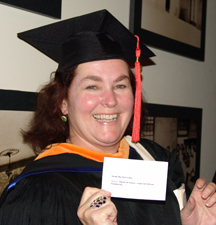
Cue card for the diploma ceremony

By the spring semester of 2006, enrollment in the SMU graduate certificate program at my company was down to two students: myself and Ming. About eight of our fellow students had graduated in May 2005, but Ming and I had started a semester later and, unlike many of that first class, had never taken more than two courses at once.

The last several semesters had been all on DVD — with so few students the company would not fly in the professors. Distance learning has many pros and a few cons. One important pro for SMU engineering students is the staff in Dallas who work with the distance students. Debra, center above, was our lifeline. Ming and I made a point of finding her in her office when we got to SMU the day before graduation.

Her warm Texas welcome confirmed that we’d each made the right choice by coming to the ceremony. In fact, all of the professors and staff who we met during our visit expressed great pleasure that we’d traveled to Texas for the event. And we were hardly in the minority – many of our fellow graduates were distance students who’d also travelled from all over the country.

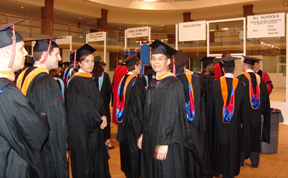
Ming stands among the other engineering graduate students.

As I accepted my diploma on a stage in an auditorium in Dallas, I silently thanked my brother–who did not live long enough to see me see it through–for giving me the right perspective

The graduates lined up by degree and school for the morning commencement ceremony. We learned that there were twice as many distance grads as on-campus students.

Unexpected Violent Femmes

Ming and I and Ming’s wife Alice explored the SMU campus and stocked up on SMU logo items at the bookstore. On Friday night Ming wanted to try mechanical bull riding, so we asked at the hotel for a bar that offered it. We were directed to a club where the bulls had been retired, but the local FM rock station was having a party. The Violent Femmes rocked the house!

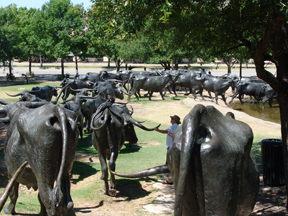
On Sunday morning before flying home I had time to visit a couple Dallas sites. I found a full-blown cattle drive, all done in bronze, in Pioneer Square.

Grassy knoll.

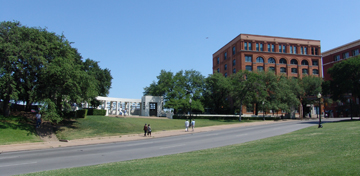
A painted X marks the spot in the street where President John F. Kennedy was shot by Lee Harvey Oswald. I visited The Sixth Floor Museum and the adjacent grassy knoll. Standing across Elm Street it’s apparent that it was an easy shot from that sixth floor window , and an equally easy shot from the grassy knoll,

I was unable to solve the mystery, if there is one, so I packed up my shiny new diploma and few home.

The Chilly Pussy Chronicles

Christmas of 2004, the east coast McCroskey family, depleted by one sorely missed member, elected to spend a few days in a beach house on the nearly deserted outer banks of North Carolina.

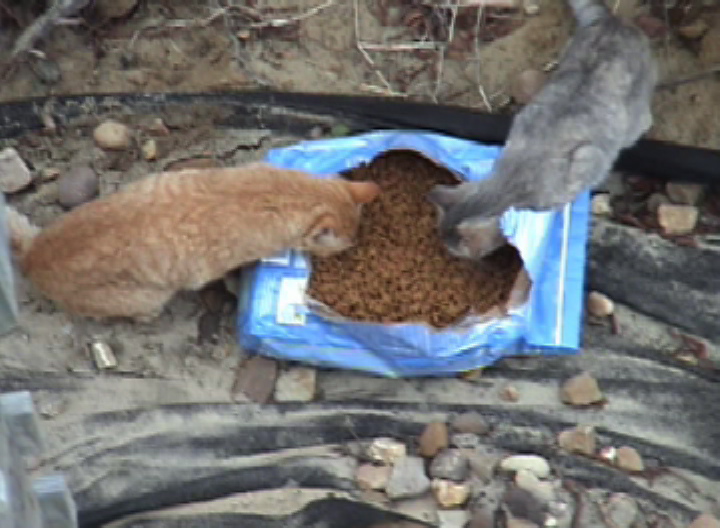
The neighborhood cats never knew what hit them.

Click the image to download the Quicktime video. You’ll need a Quicktime plug-in. If you don’t have one, visit the Apple web site for a free download.

http://www.mmvn.net/mmvn/media/Chilly%20Pussies.mov

Living Through the Surreal Days

Church meets state: Roadside message in the Bronx, September 20, 2001

The world has changed this month. On Tuesday morning September 11th two hijacked jets crashed into the World Trade Center. As I write this, I am among the many New Yorkers who cannot yet comprehend what we watched. SIAC is in downtown Brooklyn, directly across the Brooklyn and Manhattan bridges from downtown Manhattan. I sat in traffic on the Brooklyn-Queens expressway and watched the World Trade Center towers burn and collapse in the distance. This surreal sight instilled a numbness that is only now, three days later, fading. Surely this was a disaster movie. Surely those towers under which I have passed hundreds of times, where I sat and had lunch a week ago, where my hairdresser has worked miracles on my hair, have not collapsed.

But my experience was insulated by distance and the safe cocoon of my car. For three days we in this city have sought out friends, the simple phrase “Are you okay?” crossing back and forth over the struggling telephone network.

Using Sprint PCSs wireless web service and my laptop, I returned emails from friends and family while sitting in my car waiting for a ferry during my arduous journey home on Tuesday. The difficulty and expense of setting up the wireless connection a month or so ago is completely justified by this single, timely usage.

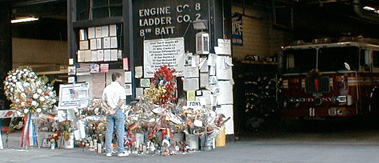
The fire station near St. Bart’s Church lost 10 men in the collapse. Local communities provided every fire station in the city gifts of flowers, candles, and donations for the families of the lost.

My call to a friend who is a New York City fire fighter on Wednesday morning woke him from much deserved sleep — weeping with relief I apologized and hung up. Later I learned that he was on site when the buildings collapsed and barely escaped.

A friend with whom I spent the day sailing on Sunday was approaching the World Trade Center in an bus when the first plane hit. He screamed at the driver to keep driving, don’t stop beneath the building. The driver went on over to the river where the passengers were able to get on a ferry to New Jersey. He was on the phone assuring his mother that he was all right when he watched the second plane strike. He spent the night in a stranger’s apartment.

Another friend was dropping off her baby at the World Trade Center daycare center. When she heard the plane hit she grabbed her child and another infant and, along with the other adults in the center, started to run. She ran blocks into Chinatown, with the help of a stranger for a while, sharing a taxi with other women for a while. Eventually she contacted the other baby’s parents, and after some difficulty managed to return their child to them. All of the children in the center, which was on the ground floor with doors to the outside, were saved.

Another American Express employee was running late for work. She was still near home when she heard the news on the car radio. She called a co-worker at the office, who did not know what the explosions she was hearing were, and ordered her to grab everyone in sight and run north. Immediately.

In the pool at Bally Total Fitness on September 13 a woman who was trying to summon the energy to swim laps explained that her neice’s husband was missing. “I just don’t seem to have any energy today,” she sighed in understatement.

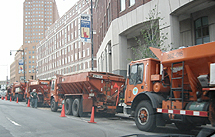
Within days of 9/11 truckloads of gravel guard the building housing NYC’s 911 headquarters.

I returned a frantic call from Antonia, the Barcelona resident who is currently in Atlanta, and shortly received email from friends of hers in Spain who were aghast that this disaster in the US could reach so far as to touch them, too, by virtue of fearing for my life.

The stories you’ve heard via the national media are a tiny sampling. The reality here is virtually impossible to convey. As I write this, in the north east corner of The Bronx, the acrid smell caried on the southerly breeze makes my tongue tingle. I could claim that it is also what makes my eyes tear up, but that would not be the truth.

Brush with Celebrity, or The Man Who Knew too Much

Antiques Roadshow is arguably the first British game show imported to the US. Average folks bring their treasures to the roadshow for professional appraisors to examine. In each city they visit the appraisers find a few gems. They film these appraisals to create the show.

The experts look at literally thousands of items to cull out two hours worth of television-worthy stuff. The items they choose to broadcast are usually special in some way, or they represent a type of item that’s currently popular, or they are not what they seem to be.

The Roadshow came to New York one Saturday in July. I had ordered the free tickets from Ticketmaster two months in advance, as soon as they were available. The show was a sell out.

Andrew opted to bring a tip top table about which he had “questions.” I was looking forward to seeing him have his table examined by one of the Roadshow furniture “stars” and hoping it would be one of the Keno brothers.

The Kenos–Leigh and Leslie–are twins who share a passion for antique furniture. One owns a prestigious New York shop, the other works for one of the big auction houses. Since Andrew’s interest rivals theirs, I hoped to see a meeting of the minds.

For myself I planned to bring a set of miniature books inerited from my Grandfather. A week before the show I decided to be an informed “contestant.” I seaeched the web for my books. In 30 minutes I found out more than I wanted to know, including several eBay auctions that gave me a good idea of their value.

No point in taking them.

I considered takinq my one truly valuable antioue–my wall clock. But it’s delicate and I’d want a written appraisal if I take it somewhere. So I turned to my jewelry box. Two pocket watches, three gold lockets, and–coolest–several pins made of gold nuggets.

We were scheduled for the 9:30 am slot, so we arrived at the much reviled Javitz Convention Center at 9:00. Volunteers directed us into a hall of lines where we waited to enter the “set.”

At the entrance our items were examined and we received tickets for the appropriate appraiser tables. Luckily, furniture, jewelry, and watches were all adjacent. A volunteer escorted us through the crowd. My first, and lasting impression of the “set” was it’s size. Watching the show one gets the impression of great space. But in reality the familiar Roadshow banners enclosed a relatiely small area within a much larger exhibit hall.

We pressed past a familiar looking carpeted appraisal stand with small objects on it–clearly awaiting their moment under the lens. Quite suddenly we were the slightly lost looking people milling around in the background while appraisers chatted with “winning” guests on camera.

“There’s a Keno,” I said as we reached our area (the brothers look enough alike that I could not tell which it was). Andrew peeled off to check in at the furniture table and I went on to jewelry. My first appraisal was quick. The gold rush pins have some value, but were not broadcast worthy. The two larger lockets were not even gold (my mother would be terribly disappointed).

As I moved on to watches I glanced over at furniture. Andrew had the attention of both Kenos, all three heads bent over the inverted base of his table.

My watches proved to be ordinary but not valuless–pretty much as I expected. I put my items and notes away and went over to furniture.

“What’s up?” I asked Andrew, who was now chatting with Wendell Garrett, who held Andrew’s table top nestled against his wheelchair. Mr. Garrett focuses on historical pieces. It turned out, he and Andrew had acquaintences in common, so they’d been having a lovely chat.

“They’re thinking of doing an over-the-shoulder. I need to speak to this producer,” he nodded at a woman in headset with a clipboard. I was amused by his rapid adoption of TV production lingo. I chatted with Mr. Garrett, who held Andrew’s table top almost lovingly, while Andrew had a short meeting with the producer.Then he stepped over to the Kenos again, and finally they all came over to Mr. Garrett and me.

One of the Kenos held the base of the table so that we could all see it.

“You see,” he said, “sometimes it’s what we don’t find that’s important. If this were an old table, there would be wear marks here. . .”

Then he inverted the base, “And I’ve never seen a table like this without a support here. . .”

Mr. Keno went on to point out a couple more improper features of the poor table. Mr. Garrett seemed as interested in the lesson as Andrew and I. The four of us hovered over it for a few minutes, Andrew and I honored to have the attention of the entire furniture staff for so long.

The conclusion? Andrew’s table was about 100 years old, not the 250 years old that its style suggested. Was it an intentional forgery? Unlikely. It was just a good reproduction. Andrew thanked the Kenos and Mr. Garrett and packed up the table, then paused to give his card to one of the Kenos, saying “you know, since this one’s not real, I’ll be looking for a replacement . . .”

Once outside of the “set” I asked what had happened with the producer, as it was apparent that they’d decided not to film Andrew and his fake table. It couldn’t be that it wasn’t genuine — they frequently show disappointments.

“I think it was a lack of shock value,” he explained. “I was asking questions that suggested that I knew what I had.”

“So you needed to act dumb, but instead you were a sophisticated New Yorker?”

This may seem like a disappointment, but in fact we were amused just to have come so close. And it was really fun to have had such distinguished experts confirm Andrew’s suspicions.